You can tell how tired someone is of the always-online life pretty easily. When they get home, watch the distance between the phone and the body. The people who love being connected never let the thing leave them be it pocket, palm, face-down next to the fork. Everyone else sets it down the way you drop a heavy backpack after a long day of walking. My wife does not set her phone down so much as launch it. From her hand to the far corner of the room, the phone travels from indispensable to litter in under a second.
For my part, I've come to resent the smartphone, which is an embarrassing thing to admit, because I used to be a believer. I researched every new model. I switched between iOS and Android just to taste each new future as it arrived. I lined up for the first iPhone at 3 a.m., stood in the dark to get a glimpse of the thing itself. I remember being genuinely moved when the Apple Store employees clapped for me. In hindsight this is mortifying, roughly on par with the year I dyed my hair blonde and shopped at Hot Topic. We used to have passionate arguments about whether iOS or Android was the future. Sitting here right now, I cannot tell you which model of iPhone is in my pocket. I can't name a single reason I'd upgrade, except that eventually the battery dies, and I don't feel like swapping it myself. Again.
It was a dream, for a while: internet everywhere, always. Star Trek made real. I could send an email from a country road. I could read a webpage from a bathroom, which, fine, is where a lot of it belonged. My first computer had no networking at all, and then: dial-up, ethernet, wireless, the phone in my pocket. Each step felt like proof that the future arrived on schedule. These were prized possessions. You cherished them. You had feelings about the merits of one versus another.
Now the smartphone is a tax. I get to choose my tax collector be it Apple, Samsung, Google, Nothing, Fairphone, but I don't get to choose whether to pay. In Denmark I'm expected to carry the Aula app for school, the Rejsekort app for trains, MitID to prove to the state that I am me, and e-Boks for official messages from the government and its authorized friends. I need the thing at the airport, at the hotel, at the gym. All of this, I'm told, is a choice. I "choose" to take part in the digital economy.
It isn't a choice in any meaningful sense. It's compliance. It's the one physical counter open Tuesdays from 10 to 12, and the ticket machine that no longer takes cash. And the offline option exists the way the wheelchair ramp exists at certain train stations: installed after the fact, satisfying a regulation, pitched at an angle no wheelchair on earth can climb. We are all expected to pretend grandma can make it up, and to act only mildly surprised when we find her at the bottom again.
So every few years I buy the identical slab of metal and glass. I admire the color for a moment, because color is the only decision left to make. The last honest pleasure in a new phone is peeling the plastic film off the screen after which the box contains nothing of interest. I put the slab in a case so durable I never see the color again, restore from backup, and everything the old slab knew migrates, whole and continuous, into the new one. A soul transfer, over Wi-Fi, in ninety seconds. I feel nothing for the old slab, despite years of daily intimacy. I hand it off or sell it and never think of it again.
I understood something had gone wrong in me the first time I dropped the phone and didn't mind. I was standing in my living room, mid-negotiation of a play date over WhatsApp, when an email arrived from my mother and a calendar alert reminded me I'd never scheduled the dog's vet appointment. It was as if the phone simply left my hands on its own. It hit the floor with that specific thonk of expensive object meeting laminate. When I picked it up and saw that the screen had survived, I was a tiny bit sad.
After that, I couldn't stop seeing everything I hated about the thing. It was like the last months of a relationship, when everything the other person does induces fury. Why am I out of storage? I don't control the size of the apps that install themselves, or whether my photos are kept at full resolution or quietly compressed into nothing. I'm not allowed to control any part of the experience, so I don't consider the disk space my fucking problem.
Apple pings me, yet again, about my three complimentary months of Apple Music. I open the App Store and find an endless sea of garbage with ads floating on top of the garbage, developers screaming for attention on the burning trash river that is the iOS App Store in 2026. My maps have ads. My apps have ads. Many of the ads are for installing more apps. My podcast app shows me an ad for a podcast about digital detox.
I get on my bike and start a podcast. The first thing I hear, at maximum volume, is a Danish advertisement for a new kind of sandwich bread. Then I learn about the grand opening of an electronics store at a mall near me. As I round the corner and join the mob of Danish cyclists, furiously ringing their bells at tourists, the hosts remind me I can subscribe to the premium edition of the podcast. I long for the days of driving through the night with AM radio, where at least the ads were interesting.
I have come to actively hate this rectangle of annoyances. It is a rectangle I carry from room to room and charge every night so it can go on notifying me, on behalf of applications I was forced to install, because somebody's OKR that quarter was "increase app installs by 15 percent." I don't need to know about the AliExpress sale. There is always an AliExpress sale.
To keep from subconsciously smashing the current slab and having to buy its successor, I started leaving the phone by the front door, next to where I stack the garbage. But the fatigue found me anyway. I'd sit down to play something and get hit with a dozen download prompts. The Steam Deck is always downloading something, or trying to. Streaming has ads now, or else the show has quietly gone missing. My wife and I say insane things to each other, like, "Which app had the show from last week?" HBO counts it off — "ad one of seven" — then detonates sports-betting commercials at maximum volume, until whatever fragile interest I had in the show dies of exposure.
There is an incredible sameness to all of it. Everyone online speaks in the same broken loop of the same ten phrases. Every streaming show (except, weirdly, Apple TV+, and who called that) is written as though I'm the stupidest person alive, plot beats arriving on schedule, like a waiter screaming the order at a customer with a head injury who has already nodded twice. Emily in Paris is on: the story of an American woman trapped in a Parisian time loop. She's with the French chef. Now she isn't. Now she is again. Different dress. Compared to what's arrived since, poor Emily is Shakespeare.
For short-form, TikTok offers a stranger's very confident opinion of an article they did not read. Instagram offers puppies and softcore pornography. For the long-form connoisseur there's Twitch, the premier cyber-dystopian hellscape, where a woman in a bathing suit films herself in a windowless room for twelve hours a day, or a man with nineteen subscribers sits in a sad home office on patchy carpet pleading, "Guys, come hang out with me!" I lingered once, out of a guilt I still can't locate, and he read my username out loud and welcomed me by name. I wanted to scream, not at him, but at the sheer horror of the situation.
The snake has begun eating itself. Netflix has shows about TikTok stars running their social-media empires. HBO has a murder documentary where most of the commentary is social-media clips of people theorizing about the murder. It's a closed loop. Soon we'll produce the documentary while the original event is still happening.
Whatever hope I had for the internet is long dead, and I've made a shaky peace with most of what killed it. We persist anyway because I can't retire and wouldn't have anything to do if I did.
How do you recharge your batteries in hell?
For me: a bare circuit board. I still like playing with tech, I just need something contained. I need something where I can just engage with something that doesn't involve a million hooks and attempts to get me to do something else.
I'd heard the MiSTer was the best way to play old video games. There are a million ways to play old video games now, and that's sort of the problem. Most "retro" devices come with fourteen million games preloaded, which means you play none of them. My whole session becomes scrolling an infinite menu of things I half-remember from the backs of comic books, dipping in and out, retaining nothing. What I wanted was fewer choices. Something that stays offline.
So I ordered one. Setup was easy: flash an SD card, run an update script, copy over the games. Then I pulled the ethernet cable out, and it kept working exactly as before which is both the entire point and, in 2026, a minor miracle. There is something deeply liberating about owning one object that does not attempt to walk me through an onboarding flow. No EULA. No cookie consent. From my television to my goddamn refrigerator, everything else in my life is clawing its way onto the internet. The MiSTer just sits there and does the job.
The refinement that made it click is TapTo or Zaparoo, depending on how old the website you're reading is. It's an NFC card system that allow for basically a physical shortcut to the game. Tap the card, the game loads. It sounds like a gimmick but it is actually the secret to why the whole thing works. It's the difference between scrolling a menu and picking a cartridge off a shelf, and it finally scratched the itch. (Time Extension reviewed it here: [link]. If you want the full rundown on what a MiSTer is and how it works, RetroRGB is the canonical source: [link].)
The short version of what the MiSTer does: software emulation is a very good impressionist doing an SNES. FPGA is reincarnation with the original chip logic rebuilt, cycle-accurate, no frame skip, able to drive a CRT if you happened to keep one. Is it objectively better than emulation? Who cares. Every slowdown, every piece of weirdness, belongs to the original game and not to some setting I need to go find. I do not open menus.
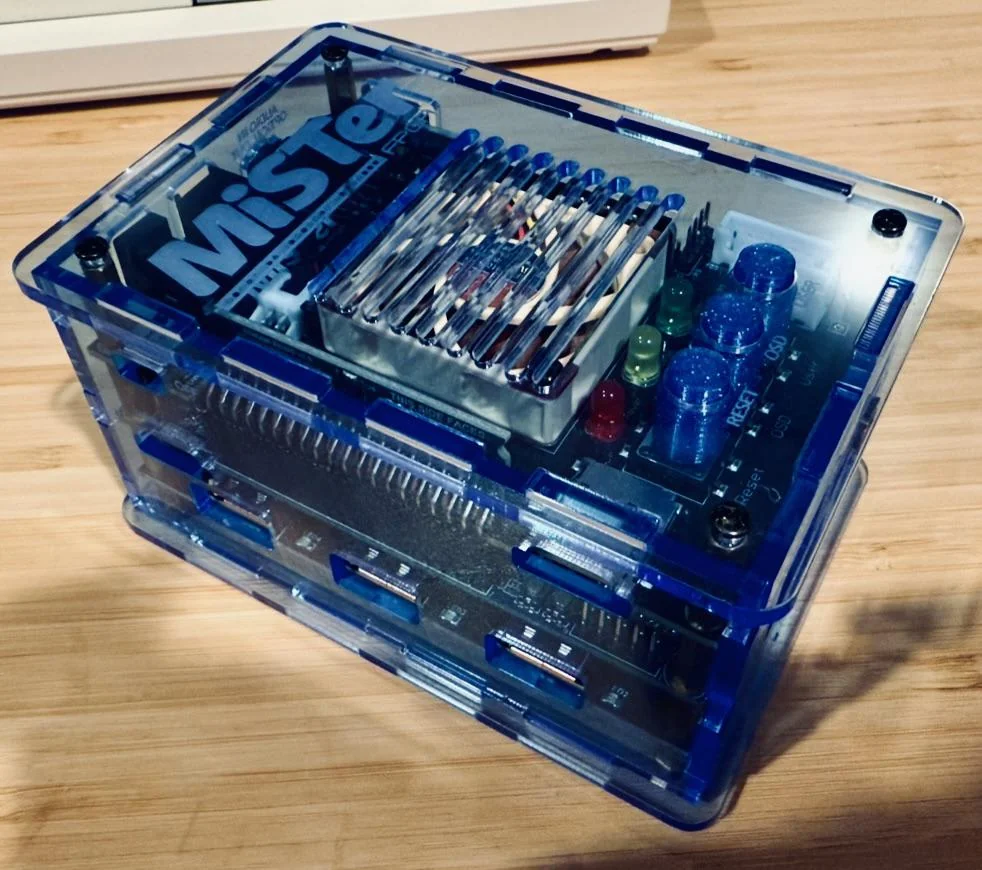
The end result looks like this (not my actual unit — I dropped it and cracked the plastic so: imagine this, but worse):
The first game I loaded was Crash Bandicoot for the PlayStation. When I played it as a kid, it was a technical marvel. It is hard to overstate how Crash looked and felt, coming from the Genesis and the NES. PS1 games in general have a soothing grammar, because they assume nothing. They know you rented this from a Blockbuster on a Friday night, that the manual is missing, and that you need to understand the game inside of thirty seconds.
Each Crash level introduces exactly one new thing, shows it to you up front in a low-stakes loop, and lets you figure it out. It starts easy. Then the mechanics stack, and stack, until the jumps demand something close to pixel-perfect, and I notice I'm leaning forward on the couch, fully dialed in to the triangle-headed marsupial.
It puts me back in the arcade at the mall a town over from my house. My dad would drop me off at the Defiance mall, which had a small arcade near the movie theater, across from the Chinese food stand in the food court. We'd line up in the dark for a shot at one of the Street Fighter II machines, quarters stacked on the bezel to call the next game. The carpet was always weirdly sticky. The joysticks were still sweaty from the last failed challenger. The mechanics of that era were simple, but you had to execute them perfectly, in public.
After a few hours I take a break. I pause the game and leave the box running, and hours later I come back to find everything exactly where I left it. No session expired. Nothing has decided I need to log in again. It just keeps humming, the little fan I installed purring away. It exists to keep doing the thing I asked it to do, and it has no other ambitions.
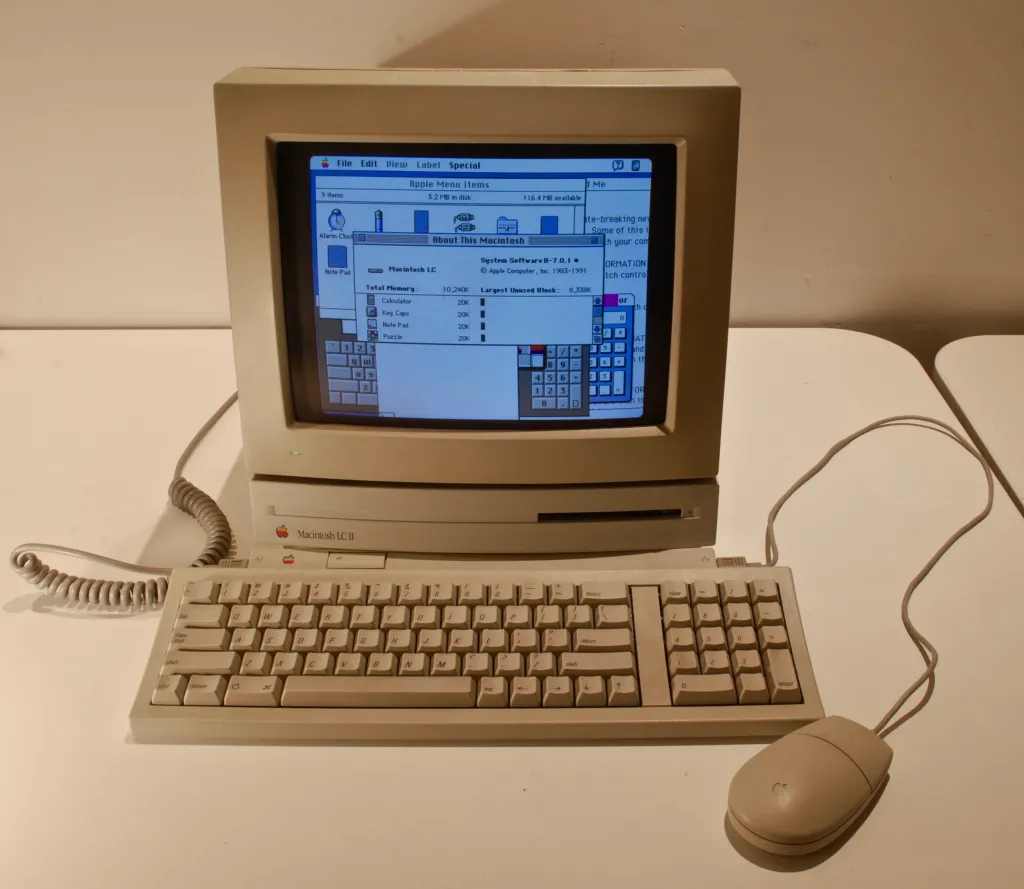
When we first got computers, this is simply what they were. By default they did nothing. They sat there and waited for you to have an idea. My old Macintosh LC II would basically wait around for inspiration to strike, or for me to waste an afternoon opening and closing folders, because software was expensive and folder-clicking was free. They felt like tools, not toys, and (ironically) the reason we knew how to do anything on them was that we spent hours poking around System 7, figuring out where everything lived. They crashed. Often, if we're being honest. But nothing in that machine wanted anything from me.
Is the MiSTer perfect? No. It's a board engineers test things on, and the software is flawed in exactly the ways you'd expect software like this to be flawed. The UI is clunky, pairing your first controller sorta sucks, and at no point has anyone optimized my experience. But it exists not as the physical manifestation of some roadmap I'll be subjected to later, but as a snapshot of a thing that exists on its own terms. Like the LC II, it's a thing designed to do a thing. It sits there with wires dangling out of it, doing exactly that.
It asks nothing of me. It knows nothing about me.