FDR has always been one of my favorite presidents, second maybe to Lincoln. Both were men the establishment assumed were one of them until, to their horror, they governed like they weren't. Both could trash the opposition in one breath and take the moral high ground in the next. One of my favorite Roosevelt lines growing up came from Madison Square Garden, October 1936, standing before a crowd that included plenty of people who wanted him dead:
Never before in all our history have these forces been so united against one candidate as they stand today. They are unanimous in their hate for me—and I welcome their hatred.
What I love is that he doesn't argue with the hate. He doesn't say they're wrong to hate him, or that the hate is unfair. He says the hate is evidence. The process is working. I've always treated it as a metric: if you're doing something hard and nobody hates it, you probably aren't doing it. If the right people hate it and those people happen to be some of the worst people alive, so much the better.
By that standard, the GDPR (Europe's General Data Protection Regulation) is doing beautifully.
The Cursed Banner
It is impossible to go anywhere in a technology space online without hitting a wave of commentary about how stupid GDPR is. It was written by bureaucrats who don't understand the amazing potential of unrestricted technology. These US-based critiques almost always lean on the oldest trick in cyberlibertarianism: we don't have time to regulate, we must simply adapt and ride the wave. Nobody has time for government.
Of all GDPR's consequences, none gets more attention than the cookie banner, which critics present as the inevitable result of government meddling. Blaming GDPR for the cookie banner is like blaming the health inspector for the roaches. The banner is deliberate vandalism, a dark pattern engineered to exhaust you before you can learn anything about the surveillance apparatus humming behind the "OK." Ironically the banner designed to hide the machine has taught the public more about the machine than a thousand podcasts ever will. Even non-technical people stop at "your data is shared with 996 partners."
"For a sports score website?"
So why is the tech commentary community so loud about this? Because they understand what's at stake. If consent must be freely given and easy to refuse, the industry's power shrinks exponentially. People might decide who has their data, how long it's kept, and what it was collected for. You can only imagine how that thought keeps a Meta executive up at night when he's not eating endangered animals, or ignoring calls from his children whose names he has forgotten while on a tacky yacht.
Consider the following example. Did you know Google was doing this every single time you searched on Google? Did your dad? So even in the most maliciously compliant form the regulation does provide value and information.
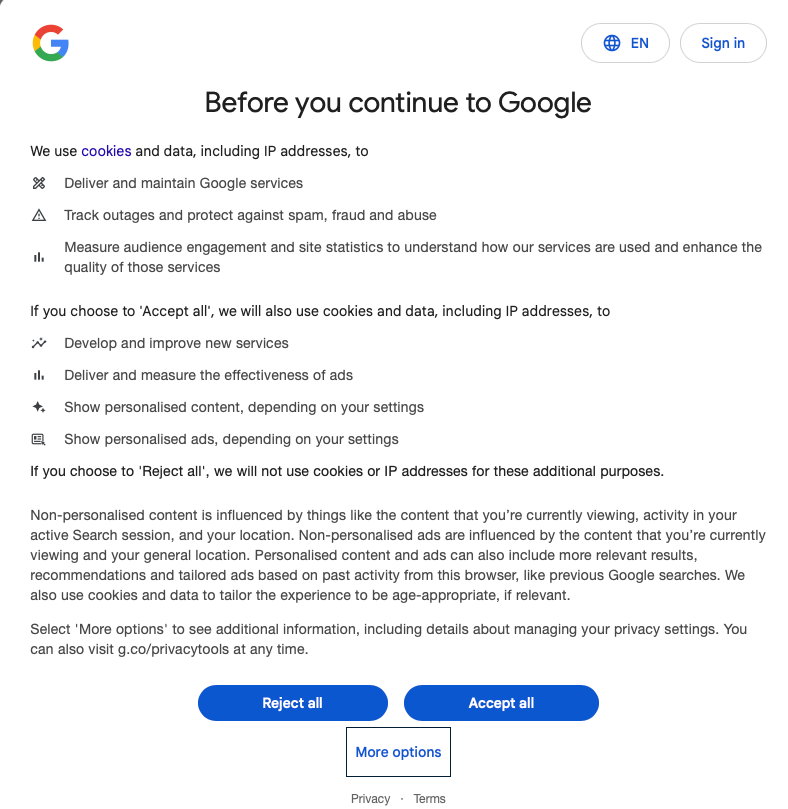
Remember the hatred is the metric. How did we get here, where US tech companies end up regulated by Brussels? Why isn't the US government regulating US corporations anymore? If the rules are so terrible, why did nobody choose market exit? Has the EU become the world's "privacy cop" or, in the inverse, the biggest player to protect a fundamental human right to privacy?
GDPR Day
Ah who doesn't remember where they were on GDPR Day. Since we're all socialists in the EU, we stood up from our government issued desks and gave the required three cheers for regulation, then resumed being on vacation for 6 weeks. Obviously after stopping by my free doctor on my way to the airport. On May 25th, 2018, GDPR took effect to the sound of American commentary, the way fireworks take effect to the sound of dogs.
You can tell American CEOs were aware of the regulation based on the speed by which they copied the language from it. Right before it took effect Brad Smith, the president of Microsoft, tweeted "We believe privacy is a human right." Tim Cook was right behind, telling CNN that "privacy is a fundamental human right". The framing of privacy as a human right is one of the key elements of the EU approach with GDPR. This is in stark contract with the US legal system which views information privacy as more of a market problem. You are all informed individuals in the wide marketplace of data exchanges and are left mostly to your own devices. In theory there should be regulations by the US of things like unfairness, deceptions and other market failures but in practice that doesn't happen.
Europe is no stranger to this fight. The German state of Hesse passed the world's first data protection law in 1970, also known as the year the Beatles broke up, and set a standard we still fail to meet today:
The records, data and results covered by data protection shall be obtained, trans-
mitted and stored in such a way that they cannot be consulted, altered, extracted
or destroyed by an unauthorized person. This shall be ensured by appropriate
staff and technical arrangements.
At the launch of GDPR there were 126 countries with data privacy laws of some sort.
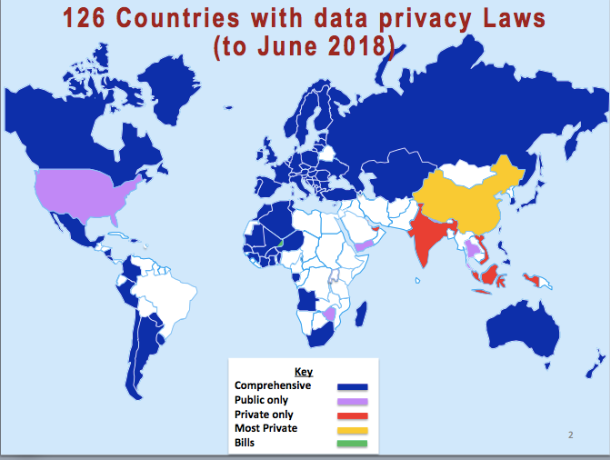
What you see with this sea of legislation is an overwhelming consensus that what GDPR was attempting to do was correct. In fact you see a pretty high level of global convergence of standards. All 126 laws descend from the same commandments the OECD carved in 1980: collect only what you need, say what it's for, keep it safe, let people see and correct it, and don't be a creep about any of this. Fifty years later, the American internet industry is still stuck on commandment one.
So first the often-repeated sentiment that this is a flight of EU fancy is straight up incorrect. Something you could describe as the "European standard" for data privacy quickly became a global standard.
Why Did GDPR Spread so Quickly?
Anu Bradford calls it the Brussels Effect: Europe regulates, the world complies, because despite American bluster, Europe is a market nobody can leave.
In the US financial market, companies who surrendered the EU market would have quickly found themselves with new CEOs as their previous leaders suddenly discovered health problems or a deep love of their families that they had ignored for years. Especially given the increasingly frosty relationship between the US and China, companies that were pushed out of China due to regulation and increased domestic competition cannot lose the EU market. It's also difficult to screen a lot of services for EU customers, especially because the laws follow the personal data of EU residents whenever and wherever the information is transferred outside of the EU. Think of it like trying to sort luggage based on what stickers are on the outside.
The EU is also set up in such a way where enforcement of such a law becomes possible. Every member state has a Data Protection Authority, who are charged with assisting individuals in protecting their rights, advising domestic legislatures on the functioning of existing regulation and finally enforcing the law. The EU is also different from the US in that it is open to exploring precautionary regulatory action. We see this with the EU Artifical Intelligence Act which tried almost immediately to get some controls on the industry right at the beginning. Link So the combination of a robust option for enforcement combined with an increased appetite for regulation in general and a high level of respect for personal privacy made the EU the logical source for this legislation.
Want to know what the teeth look like? In 2011, an Austrian law student named Max Schrems asked Facebook for everything it had on him and got back 1,200 pages, much of it stuff he'd never volunteered. He filed a complaint from a dorm room. Four years later, the Court of Justice of the EU had voided Safe Harbor, the transatlantic data treaty, on the strength of it. A college student complaint killed an international agreement signed by presidents and prime ministers....multiple times.
Japan and the EU
The best proof of GDPR's power is what it did to Japan. On January 23rd, 2019 the EU and Japan reached a deal which allowed for the free flow of personal data between the two economies. It established an overarching privacy law with a core set of individual rights and enforcement by independent supervisory authorities. The process took 2 years, which isn't a surprise because before this process Japan had very weak, swiss-cheese regulations.
In 2014 Graham Greenleaf chose the title "The Illusion of Protection" for his chapter about Japan in an overview of Asian privacy laws. The private sector was basically unregulated, it has "easily manipulated exceptions" to its rules concerning the use and disclose of personal data, its absence of provisions for sentivie information and had no restrictions on data exports. It was nowhere near the level of protections that the EU would expect for information sharing.
You can draw a straight line from a bargaining table in Brussels to new rights for a retiree in Osaka. Japanese data brokers hate it, which again is the point.
Why hasn't the US sought the same arrangement? Because everyone involved knows the application would be denied. Which raises the real question: why can't the country that invented most of this technology produce a rule for it? Why is the US stuck pretending there's no reason to regulate while the rest of the world moves on?
The US and Surveillance Capitalism
There's no better text on what has happened in the US with the data economy than The Age of Surveillance Capitalism by Shoshana Zuboff. It's a good read and I won't ruin it for you.
First, the definition of Surveillance Capitalism from the book.
1. A new economic order that claims human experience as free raw material for hidden commercial practices of extraction, prediction, and sales; 2. A parasitic economic logic in which the production of goods and services is subordinated to a new global architecture of behavioral modification; 3. A rogue mutation of capitalism marked by concentrations of wealth, knowledge, and power unprecedented in human history; 4. The foundational framework of a surveillance economy; 5. As significant a threat to human nature in the twenty-first century as industrial capitalism was to the natural world in the nineteenth and twentieth; 6. The origin of a new instrumentarian power that asserts dominance over society and presents startling challenges to market democracy; 7. A movement that aims to impose a new collective order based on total certainty; 8. An expropriation of critical human rights that is best understood as a coup from above: an overthrow of the people’s sovereignty .
Didn't read that? I don't blame you. In English they found oil and the oil was us. And as us Americans love to do, we immediately discovered a sudden love of freedom in the presence of oil.
Effectively here's what happened. The 9/11 terrorist attacks had a ripple effect in US regulations, effectively derailing the momentum that the domestic US regulatory organizations had about starting to build frameworks around personal data. The focus became on security and not privacy. Quickly public intelligence agencies and the fledgling surveillance capitalist business in Silicon Valley found each other and carved out the concept of "surveillance exceptionalism". If you were spying to keep us safe, then it's not spying it's public service.
As time went on, the corruption of American politics rendered the possibility of regulation less and less feasible at the federal level. Google and Facebook poured tens of millions into lobbying (for non-US readers, lobbying is a nice way of saying bribery that is legal). There also became an "open door" between government and tech, with 197 people moving back and forth from Washington to the Googleplex.
What these companies learned is that by studying our behavioral data during periods of relaxation or play was the most value, allowing them to accurately and reliably push people towards profitable outcomes. US consumers were aware of this to some extent, often repeating phrases like "If it's free, then you are the product". That was true before, but in the new digital economy it is no longer true.
We're not even the product anymore, which is why all these companies no longer give a solitary shit about whether their stuff is good or fun to use. We're the raw material that they mine. They know every single thing about us and we don't know anything about them. They accumulate all the data from us but not for us or for our benefit. Behavioral modification though the accumulation and manipulation of this data is now the wealth engine of the United States.
Now we are in a market failure scenario. No individual company will disarm first, and any regulator can be captured for what these companies spend on catering. Only law with real enforcement teeth changes the math. And the US cannot pass laws with teeth anymore, not because voters don't want them (polling says they do), but because the pipeline is purchased. When someone says America "can't" regulate tech, they mean it the way a hostage "can't" reach the phone. GDPR didn't spread because Europe is heroic. GDPR spread because Brussels is what fills the room when Washington leaves it.
What does surveillance capitalism look like?
Thanks to the amazing https://decryptads.com you can see what it looks like in real time. Let's take The Verge.
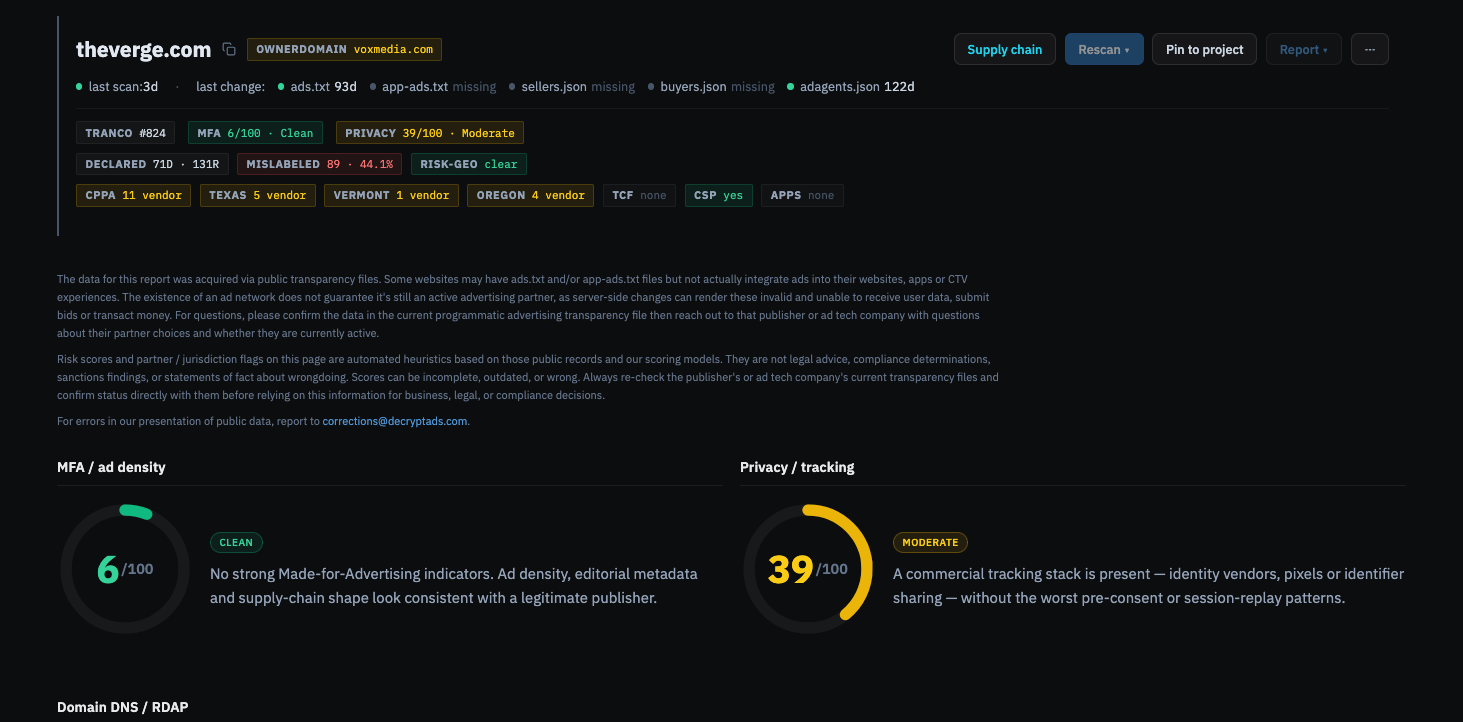
This is a relatively straightforward tech commentary website that has a paywall. It should have a very simple supply chain in terms of advertising.
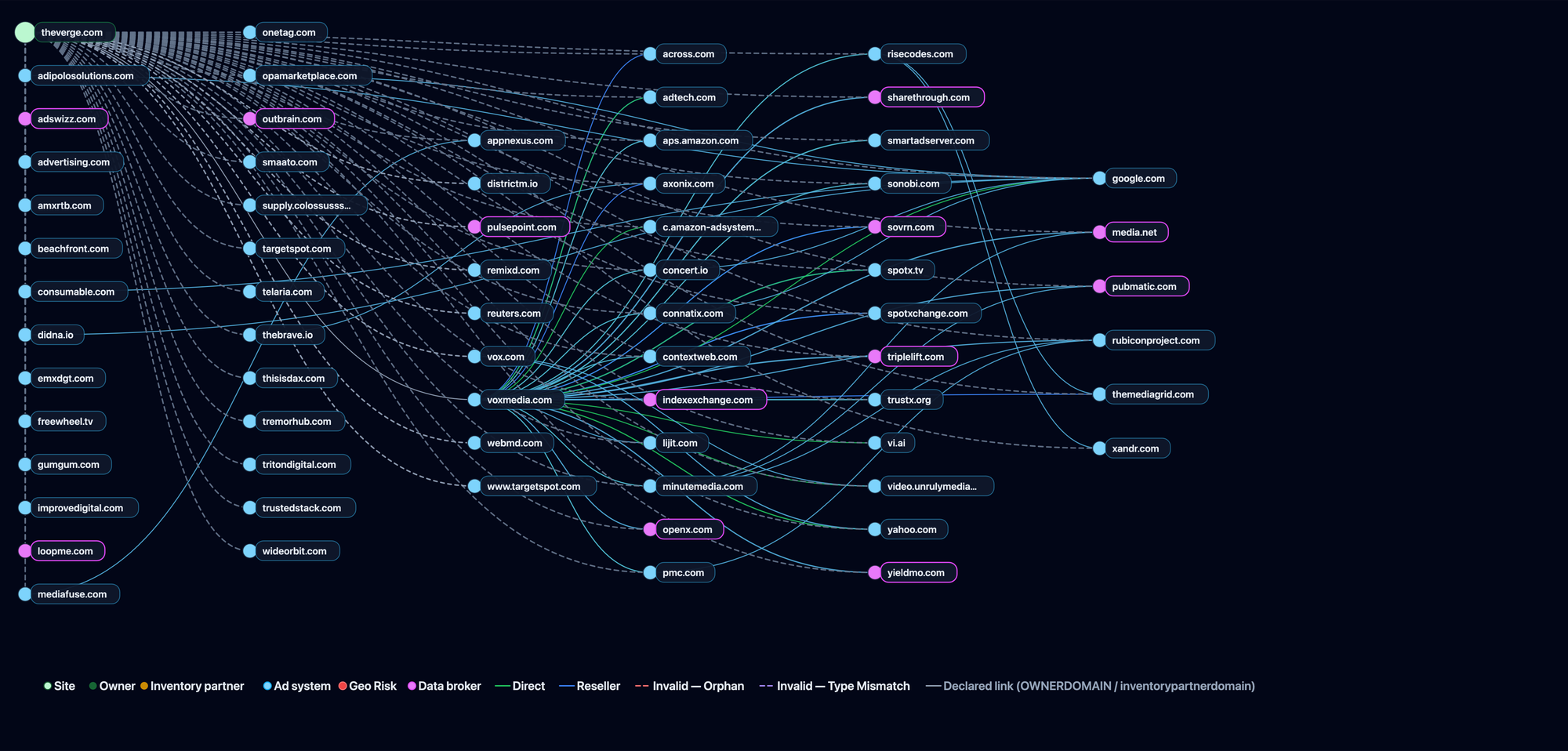
What we see is the opposite. There is a giant network of companies trading, selling and bidding on the information from this website. This isn't the fault of The Verge, this is just how the machine operates. Your data is like fish at a fish market. Everyone gets to inspect the merchandise and decide whether they want to buy without you being involved. Ironically we only get this information because of the ads.txt and sellers.json which exist to combat advertising fraud.
Even a well-run website operated by technologically literate people geared towards tech enthusiasts behind a paywall is not immune to this system. What you see here is that there is no fucking escape. If you want to have a large web presence and have bills to pay, you need to participate. And The Verge is doing it right! 59 declared partners and none of them are actively preparing for war with the US.
In the US though this is not a new problem.
Double Movement
The economic historian Karl Polanyi came up with the concept of "Double Movement". You can read it here.
Think of it like this. Imagine you strip American Capitalism down to a tug of war. In the first round, the businesses go first. This is the "let the invisible hand decide" part. Everything becomes a product you can buy and sell including land, work, even money itself. Think of this like removing all the referees from a game and letting players do whatever they want.
Then there is round 2, which is "wait this is hurting people". People demand protections like minimum wage laws, workers rights and trade regulations because the "free market" never seems to regulate itself but is causing real harm. The referees come back, but now with a rulebook written by the players who got hurt.
His argument is that a totally free market is a fantasy. It's a fantasy because markets need government support to operate. Even people who pretend they despise government interference rely on them. Copyright and trademark doesn't matter when you need to train an LLM, but it matters a whole lot when I start marketing my iWatch smart watch.
That rhythm of abuse, then correction governed American capitalism for a century. For surveillance capitalism, round two never comes. There is no functional federal counterweight as I write this in 2026. Some states are trying, and good for them, but regulating the internet state by state isn't progress it's just stopping the bleeding. Meanwhile the brokers buying and selling your life exist entirely outside your scrutiny, have no fear of comprehensive reform, and can swing a statehouse election for what they spend on a quarter's catered lunches. Entities this powerful cannot coexist with a functional democracy — a fact they seem to have considered, given the rise of the "Nerd Reich". https://www.npr.org/2026/08/10/nx-s1-5925350/the-nerd-reich-tracks-the-unmasking-of-silicon-valleys-true-politics
So the order of operations is simple. Washington can't act, so Brussels does. Brussels acts, and the world follows, because the market is too big to leave. That is the whole story of GDPR: not European ambition, but American absence. A sign of the declining empire if you will.
Roosevelt gave that speech at Madison Square Garden on the last night of October 1936, and a week later he won forty-six states. The people who hated him got Maine, Vermont, and the next ninety years of being wrong about everything they hated. That's the thing about being hated by the right people which is it is a currency and a valuable one.
Privacy regulation will get there too. Not because the industry repents because industries don't, but because this is how every one of these stories ends: seatbelts, smoking sections, lead paint. Normal, then scandalous, then unthinkable. Someday someone will ask what an ad network for children was and refuse to believe the answer. And the executives who fought this will be on a boat somewhere, explaining that they were for it all along.
Accept all.