Skip to content

In Purgatory Everyone Likes Crepes: My Time at a Greek All-Inclusive


I can’t remember the last time I was actually hot. It’s a thought that keeps looping through my head as I stand next to a children’s play structure in a Greek all-inclusive waterpark. The sun is beating down on an international community of mostly parents drinking watered-down cocktails out of plastic cups while their children scream and run in circles. Surrounding this little paddock of plastic is a lazy river, filled with mothers and fathers staring blankly into the middle distance as they slowly orbit the water toys. It’s all concrete and aggressively bright primary colors, suffused with the smell of gyros being cooked by a Filipino staff behind me.

Living in Denmark, it’s rare for the sun to shine directly on you. Typically, everything outside looks like it has a blue filter placed over the lens—like how TV shows put a yellow filter over the camera to establish that you are now in Mexico. Sometimes in Copenhagen you might get hot, but then it will immediately start to hail on you, and you suddenly have a different, worse problem. Greece, by contrast, feels like the sun is noticeably closer to the earth. It feels personal, like a heat lamp pressed against your skull.

My daughter has been playing peek-a-boo with a cute baby on a bench next to this water playset for long enough that I feel a moral obligation to go over and say hi to the mom. She’s a nice woman, watching four kids at a waterpark alone with a casual calm I actively envy. I’m a little stressed keeping eyes on just one, but she has four kids ranging from around ten to two, running around and disappearing beneath the waves, only to emerge just before I would panic. She has a small sunburn on the small of her back that I assume she either can’t reach or forgot—a small, raw triangle of red.

We chat briefly. She asks where I live; I ask the same. I’m surprised when she answers Russia, mostly because I don’t get much exposure to Russians in Denmark. I clearly make a face without meaning to, because she quickly adds, "Their father is off fighting in the war."

Ironically, I think she added this to head off me judging her as a single mother. Instead, revealing the father is a Russian soldier has made the part of my brain that regulates politeness completely short-circuit. What is the social etiquette for the wife and children of a military power you don’t support? I’ve never even considered this question, standing here in my swim trunks, my too-pale stomach exposed to a hostile world. I don’t want her children to be orphans, obviously. Neither she nor they did anything to start this conflict. But I’m worried that expressing vague positivity will end like my conversation with an Israeli in Copenhagen who took my neutral statement, "I hope the conflict ends soon," and responded with a wink and, "It will, with Trump at the helm."

"I hope he comes home soon," I say, keeping my face perfectly neutral.

She nods and resumes throwing a ball around with her children. She seems completely unaffected by thinking about her husband, which I think is actually the strange magic of the all-inclusive resort. It is a geopolitical anesthesia. The world is burning down, but here, the ice cream machine is still running.

On most topics, I don’t consider myself a snob. I enjoy a Michelin-star restaurant, and I enjoy a nice slice of 7-Eleven pizza at 2 AM. I'll finish a thick, sad Classic of Literature and then immediately pick up Space Marines vs. The Metal Skeleton Wizard on the Moon. But on travel, I’ve always looked down on the all-inclusive crowd. Sitting one rung above a Carnival Cruise on the ladder of human decay, the all-inclusive always seemed like the most cynical way to say you had legally stepped foot in another country.

My first real exposure to this was in Puerto Rico. I would leave my bespoke 20-room boutique hotel and scoff at the barbed-wire fence surrounding the American mega-resort down the road. "Why would you fly to the Caribbean to eat at a steakhouse?" I’d say, dripping with scorn to my wife, who would nod as we walked through dark neighborhoods on our way to eat dinner in someone’s actual living room that Google Maps called a restaurant. As I traveled the world, I saw these giant compounds everywhere. I swore I’d never become one of those placid, sunburned people wandering around a sculpted grass lawn, slightly buzzed at 11 AM.

So imagine my surprise when I found myself finishing my second tequila sunrise before lunch, staring at a too-blue pool. The resort’s "activity crew" was out on Crepe Island—so named because it had a full crepe station on an island in the middle of the pool.

"Really, it's a crepe peninsula," I say to nobody. Nobody cares. They are aggressively not paying attention to anyone else. This is not a community.

A line of unlicensed, Disney-and-Nintendo-adjacent costumes are paraded out, with "Merio" closest to me. Kids kept trying to give Merio a high-five. I don't know if it was the suit or if the guy inside was just sick of his job, but he kept waiting too long to high-five the kids back, inevitably wacking them in the face or the back of the head as they moved on. Over and over, an excited child would run up, followed by a bizarre, lagging delay before the inflated hand would strike. "At some point, that's just hitting kids," I said to the ether. The woman next to me put her AirPods back in.

My wife had booked this trip as a reward to our daughter. Having been a remarkably good sport as we dragged her to such famously child-friendly vacations like "A Sheer Cliff Overlooking Icebergs in Greenland" and "Endless Climbing Up and Down Stairs in Florence," we wanted to give her a chance to just be a kid. When we asked her what her favorite vacation was, she responded with zero hesitation.

"Lalandia," she’d say, before resuming coloring in her coloring books with so much force you could see the head of the marker get pushed back inside the plastic casing. Since Lalandia is effectively a massive, indoor all-inclusive in Denmark, we figured the same concept in Greece would at least be a warm alternative.

We boarded a chartered flight direct to Greece, my first time on a flight where everything was delivered in Danish. I felt like a spy hiding among the locals, fearful they'd discover the American among them. Safe from prying eyes, I was pleased to watch the Danes engage in behaviors they usually made fun of us for. Loud conversations were had, crunchy snacks were aggressively unwrapped, and general uncouth behavior typically shunned was suddenly fair game at 30,000 feet.

Upon landing, the tour coordinator told my wife and me that we had to "run" to make our bus. My wife took off for the toilet; I grabbed the kid and the big suitcase and sprinted for the van. We then sat in the van waiting to take off for over an hour. What I hadn't realized in my heroic rush to the van was that I had left a small carry-on sitting in the middle of the airport. It was filled with snacks, coloring books, and also my wife’s wallet and passport.

The first night at our all-inclusive was understandably tense. Variations on the word "idiot" were thrown around. The next day, we got the good news that the bag was safe and sound at the airport police station on the island of Kos. So while my family went off to the pool, I went to the lobby and called a cab.

My driver arrived 30 minutes later and immediately asked, "Is it ok if you sit up front so we also take these beautiful people downtown?" The Scottish woman in the back blushed at this. I, lacking the social architecture to recognize warmth, simply thought: Wow, bold move saying that in front of her husband.

I got into the passenger seat. This, as I realized later, totally broke down the driver-passenger social construct. After dropping the charming Scottish couple off in the downtown area, my driver started telling me literally everything about his life. For the next forty minutes, I learned how his brother had been a firefighter, then one day went on vacation to Vietnam, fell in love with a Vietnamese woman, and opened the only authentic Greek gyro restaurant in Hanoi. He had a booming, theatrical laugh and was poured into a skin-tight polo shirt.

"Why are you going to pick up this suitcase your wife lost? DO WE EVEN NEED TO ASK?? HAHAHA! WOMEN!" Then he’d get deadly serious and remind me, "Children, they're the most important thing." I had spoken maybe six words at this point in the trip.

I forced a laugh, silently calculating the statistical probability of being murdered and buried in a Greek olive grove. It would be a beautiful place to die, though I worried they’d use a photo of me from this trip—pale, squinting in a baseball cap—for the Netflix documentary thumbnail. Some true crime podcast would inevitably conclude I had it coming.

At one point, he pulled the cab over to show me a flat patch of grass. "This is where I saved the island from a wildfire," he said proudly. I couldn't see any sign of fire; it just looked like a normal field with the grass crushed.

I didn't say anything, as up to this point, the conversation had been delightfully one-sided. I had mostly sat sweating through my shirt, nodding. He told me how someone had thrown a cigarette out of their car, and it had started to smolder. He had stopped and used his legally required fire extinguisher to put it out.

"It's good that I had this," he said, patting the dash. "This is why a robot can never replace taxi drivers." He then stared at me as if I were an assassin sent from Silicon Valley.

"You betcha," I said, sweating. I wanted to assure him I wasn't there to replace him with an app. My amoral peers back home were already working on it, but I personally wouldn't kill his livelihood. Just people who looked and sounded exactly like me.

I kept poking around silently instead, but then he caught me looking at the giant bulldozer sitting twenty meters away, its tracks leading directly to the field. I'm a genius like that.

"Yeah, alright, also the bulldozer helped a bit to put the fire out. But mostly, it was my fire extinguisher." The bulldozer was merely an accessory after the fact.

He then changed the subject by telling me that Tom Hanks had sat in his taxi "right where you are sitting." "Did you know Tom Hanks loves Greece and we love him? He is such a friend of Greece that we gave him a passport." Is Tom Hanks Greek? I thought, staring out the window. Why are there so many interior decoration stores? Is everyone on this island redoing their bathroom?

"Tom is so nice, we love him." My brain returned absolutely no information about Tom Hanks, which frankly is typical of my mind. He clearly wanted me to respond with a Tom Hanks factoid, but all I could think to say was, "Yeah, his son was really good in Fargo."

"HIS SON? Who is talking about his son?" He took the conversation back over, explaining how Tom Hanks’s wife had sat in the back of the cab while Tom sat in the front. Weird choice, Tom, I thought, looking for a sign we were wrapping this trip up.

When we arrived at the small airport, he parked randomly outside the main building, basically just the corner of the road that led from the airport back to town. "Wait, are you coming in with me?" I asked, confused.

He nodded, saying it would "take way too long" if I went in by myself. Suddenly we were concerned about efficiency. He marched us in, knowing everyone who worked there. I found myself in a small police office that definitely didn't understand the separation of church and state. There was a massive crucifix on the wall, and each police officer's desk was covered with a Jesus mousepad and a large picture of the Virgin Mary. My cab driver and the police officer negotiated the release of the suitcase in front of me without bothering to involve me. At some point, I was told I could take the suitcase and get out of here. Nobody had asked me any questions except to quiz me about the contents of the bag.

On the way back, we stopped for tea because, truly, what is a taxi meter at this point? We'd been in the car together for like two hours. He told me how his mother-in-law had almost died from a heart attack. "It's good that she could get to Athens in time," he said. He then told me how during the off-season he harvests olives from his family farm and has them pressed down the street. "It's heaven working the fields with your family."

I imagined my siblings and I being asked to harvest olives in the beating sun and immediately envisioned four body bags in the shade of an olive tree.

I nodded, staring out the window at a fire extinguisher store across the street, where what looked like a 12-year-old boy rolled a cigarette seemingly one-handed and lit it while sitting on top of a barrel. The long grass around the fire extinguisher store seemed primed for a fire. What happens if a wildfire hits a fire extinguisher store? I pondered, while my driver went on about the beauty of the Mediterranean or something I wasn't paying attention. Then we packed it up and went back to the hotel.

"Thanks for a nice morning, Mark," he said fondly to me as I got out. My name is Mat. But I guess if you've saved the island from a wildfire, you can call me whatever you want.

I got back just after Mini Disco. This was a one-hour dancing marathon for the kids in the semi-enclosed theater. With two fully manned drink stations on either side of the stage, it was an opportunity for children to dance while their parents drank like an asteroid was imminent. The songs stayed the same every night, but on this first night, we were going to learn a valuable lesson: Always buy the t-shirt.

Apparently, while I was learning the ins and outs of the Greek cab business, a nice woman had asked my wife and daughter if they wanted to buy a t-shirt for the Mini Disco. My wife, smelling a tourist scam, had hard-declined. What she didn't realize was that the climax of the Mini Disco was a formal t-shirt presentation ceremony. Each child's name was called, they were presented with a t-shirt, and then they were allowed to hug Leo the Lion.

My daughter didn't understand that she didn't have a t-shirt. So, when the name "Eleanor"—which is not her name—was called, my daughter hopped up and snagged the shirt. This meant my wife had to rush onto the stage, rip the t-shirt out of our daughter's hands, and hand it to the sheepish little girl whose shirt it actually was, all while holding a cocktail. It was a masterclass in parenting under the influence.

The next day, we were on the hunt to put in an order for the t-shirt, having made the most serious promises parents can make to a child. After we chased down the red-haired French woman running the kids' merch table, we went to the main pool. She didn't seem surprised to see us come crawling back. I got the sense the first day she was doing the sales pitch, then after that she just waited for us to come to her.

There is a weird etiquette to pools and British people. They will rush out the second you are legally allowed to put a towel down on a chair, meaning from 8 AM to 1 PM, there isn't a single open seat. The British treat pool chairs the way trench soldiers treated no-man's-land: as hotly contested territory worth dying over. But if you are lazy like my family is, you just wait. They start to leave the pool around 1 PM, and you can get a great seat with zero work. The next day, you repeat the entire cycle. That evening, kiddo got her shirt. It was a proud moment; she clutched her blaze-pink t-shirt to her chest and teared up with pride.

Soon, the days started to blend together. At some point, we all got an emergency text message telling us about wildfires on a neighboring island. I assumed the resort staff would need to calm down the crowds, as you could pretty clearly see the smoke from the fire. The sky was turning a dark, orange-brown in the distance, and the air smelled like burning rubber.

Nobody cared at all. A thousand people looked at a Greek text message they couldn't read, put their phones down, and picked up their beach reads. The apocalypse was met with a shrug. As an allegory for global warming, there is something particularly bleak about people dancing in a pool to 90s boy band hits as a thick plume of wildfire smoke shoots up into the sky. Thankfully, here nobody pretends to care about anything, so I was able to slip back into a soothing apathy. In a world that was constantly asking me to pay attention to some fresh horror, this was a place that asked nothing of you.

Toward the end of the trip, we decided to head down to the small town and were dropped off at Dolphin Square. We started walking around, looking at Google Maps to see what we should look at. There was a Roman House, which is basically an empty lot full of pieces of old Roman architecture and a sign saying I needed to pay 10 euros a person. Since nobody was there to collect this 10 euros, the sign felt more aspirational than practical. Someone should pay this Greek island 10 euros, but not today, I guess. But I looked at the old rocks.

My daughter was unimpressed. She looked at the ruins, looked at me, and asked if she could get ice cream. "Denmark has a lot of old stuff," she said, which, in her defense, is true. We walked around a bit more, buying little tourist trinkets. I'll never understand who buys the t-shirts that fill the small streets of these towns. Who is the demographic for a shirt that says "I heart my boyfriend"? And more importantly, where is he? Does he buy the t-shirt for you before you go on a solo trip without him?

But we went to a small restaurant and had a proper meal for the first time in days. Despite the heroic efforts of the staff at the resort, it was actually hard to eat there meal after meal. The culinary philosophy seemed to be "cook the will to live out of it." Everything was either fried and dried out beyond belief, a hard puff pastry, or so bland you couldn't really tell what was going on. The lamb sorta tasted like the chicken, which tasted a lot like the pork, which tasted like a cry for help. At one point, we went to an Asian-themed restaurant on the resort, and I was served "duck with Chinese pancakes." The duck was well-cooked, but the pancake was an Old El Paso flour tortilla. I couldn't help but feel like the duck died for no reason.

At one of these meals, where my daughter pounded another plate of french fries and pizza, a British woman at the table next to us told me how her entire family looked forward to this trip. She started to tear up as she explained that she and her husband had worked extra hours this year to make it so their kids could come with them. "It just makes me burst with pride to think about," she said. As she spoke, one of her kids sat beside her, wearing noise-cancelling headphones, staring at an iPad, and methodically eating an entire pepperoni pizza without making eye contact with another human soul.

By the end of our week, I was eating meals of plain bread with watermelon and coffee. My daughter was consuming what looked like a kilo of Nutella, and my wife and I settled down for another cycle. We only ended up going to the actual beach, which was beautiful and maybe 200 meters from our hotel room, once. The ocean was beautiful, with rolling hills in the background, perfect warm water that was the saltiest water I've ever been in. It was like swimming in a giant, warm tear. Everyone but me hated it because it wasn't as nice as the pools.

"Ugh, there are ROCKS!" my daughter shouted, upset at the audacity of the ocean for existing. Honestly, the rocks hurt a fucking ton, but I was too self-righteous to admit it. "Let's enjoy nature, everybody!" I yelled, bleeding from the feet.

I thought by the end of my time with these people that I would come to think less of them. I expected to leave despising their complacency. Instead, I found myself weirdly protective of these folks. They are just trying to make some childhood memories with their kids, trying to manufacture something, anything that looks like a normal childhood in a world burning down.

I won't lie, the all-inclusive life isn't the life for me. It is a place out of time, where the enjoyment of it requires a total suspension of your relationship to the outside world. But I do now understand the appeal of not being challenged. In a time when everything is being questioned and every tradition and norm is falling apart, this is a callback to frankly an easier time to be alive. And we ended up getting the t-shirt, which, when you break it down, is really the most important part.



Slack: The Art of Being Busy Without Getting Anything Done

Slack: The Art of Being Busy Without Getting Anything Done

My first formal IT helpdesk role was basically "resetting stuff". I would get a ticket, an email or a phone call and would take the troubleshooting as far as I could go. Reset the password, check the network connection, confirm the clock time was right, ensure the issue persisted past a reboot, check the logs and see if I could find the failure event, then I would package the entire thing up as a ticket and escalate it up the chain.

It was effectively on the job training. We were all trying to get better at troubleshooting to get a shot at one of the coveted SysAdmin jobs. Moving up from broken laptops and desktops to broken servers was about as big as 22 year old me dreamed.

This is not what we looked like but how creepy is this photo?

Sometimes people would (rightfully) observe that they were spending a lot of time interacting with us, while the more senior IT people were working quietly behind us and they could probably fix the issue immediately. We would explain that, while that was true, our time was less valuable than theirs. Our role was to eliminate all of the most common causes of failure then to give them the best possible information to take the issue and continue looking at it.

There are people who understand waiting in a line and there are people who make a career around skipping lines. These VIPs encountered this flow in their various engineering organizations and decided that a shorter line between their genius and the cogs making the product was actually the "secret sauce" they needed.

Thus, Slack was born, a tool pitched to the rank and file as a nicer chat tool and to the leadership as a all-seeing eye that allowed them to plug directly into the nervous system of the business and get instant answers from the exact right person regardless of where they were or what they were doing.

My job as a professional Slacker

At first Slack-style chat seemed great. Email was slow and the signal to noise ratio was off, while other chat systems I had used before at work either didn't preserve state, so whatever conversation happened while you were offline didn't get pushed to you, or they didn't scale up to large conversations well. Both XMPP and IRC has the same issue, which is if you were there when the conversation was happening you had context, but otherwise no message history for you.

There were attempts to resolve this (https://xmpp.org/extensions/xep-0313.html) but support among clients was all over the place. The clients just weren't very good and were constantly going through cycles of intense development only to be abandoned. It felt like when an old hippie would tell you about Woodstock. "You had to be there, man".

Slack brought channels and channels bought a level of almost voyeurism into what other teams were doing. I knew exactly what everyone was doing all the time, down to I knew where the marketing team liked to go for lunch. Responsiveness became the new corporate religion and I was a true believer. I would stop walking in the hallway to respond to a DM or answer a question I knew the answer to, ignoring the sighs of frustration as people walked around my hoodie-clad roadblock of a body.

Sounds great, what's the issue?

So what's the catch? Well I first noticed it on the train. My daily commute home through the Chicago snowy twilight used to be a sacred ritual of mental decompression. A time to sift through the day's triumphs and (more often) the screw-ups. What needed fixing tomorrow? What problem had I pushed off maybe one day too long?

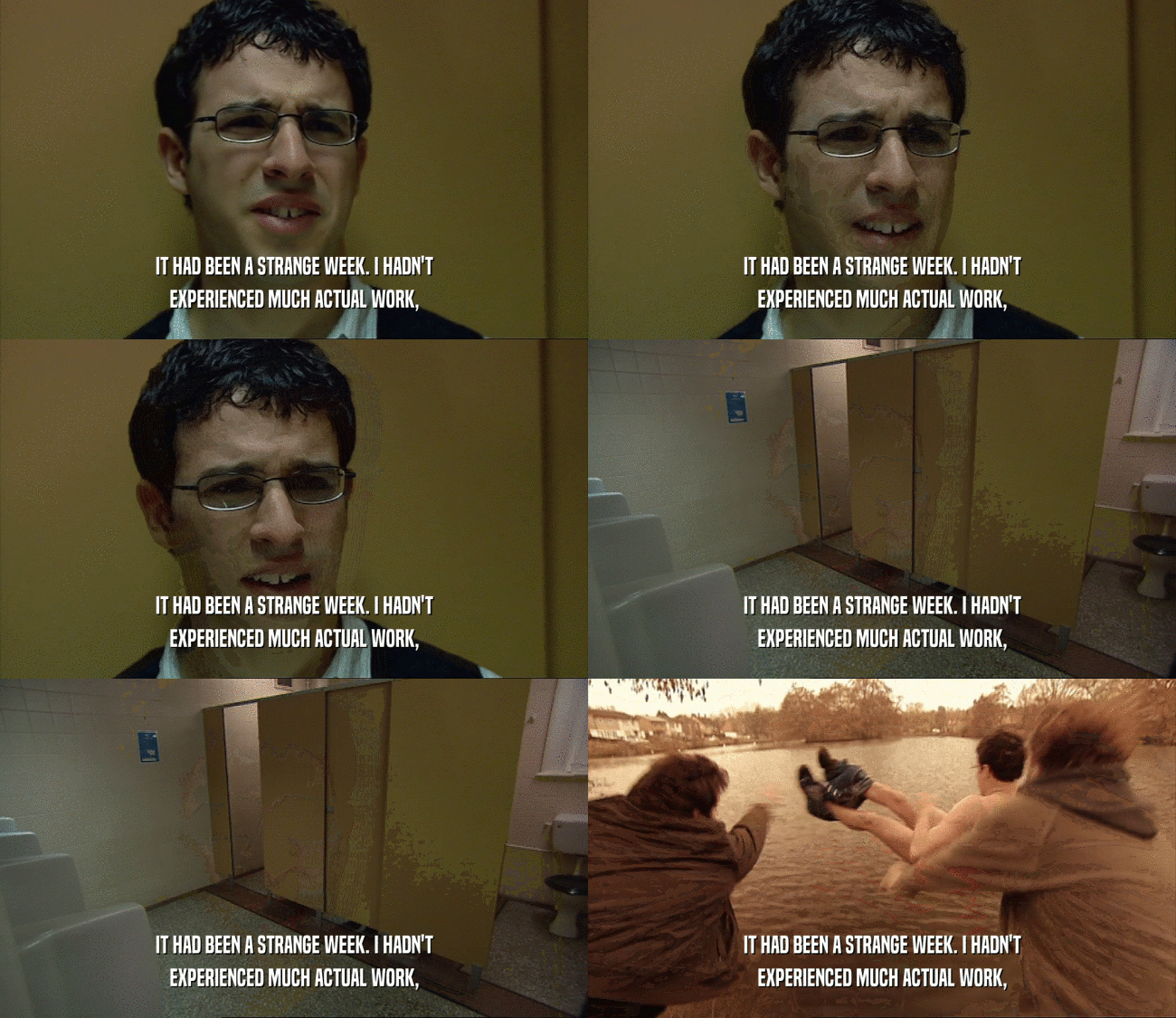
But as I got further and further into Slack, I realized I was coming home utterly drained yet strangely...hollow. I hadn't done any actual work that day.

The Inbetweeners Of Gentlemen | GIFGlobe
IT HAD BEEN A STRANGE WEEK. I HADN’T EXPERIENCED MUCH ACTUAL WORK,

My days had become a never-ending performance of "work". I was constantly talking about the work, planning the work, discussing the requirements of the work, and then in a truly Sisyphean twist, linking new people to old conversations where we had already discussed the work to get them up to speed on our conversation. All the while diligently monitoring my channels, a digital sentry ensuring no question went unanswered, no emoji not +1'd. That was it, that was the entire job.

Look I helped clean up (Martin Parr)

Show up, spend eight hours orchestrating the idea of work, and then go home feeling like I'd tried to make a sandcastle on the beach and getting upset when the tide did what it always does. I wasn't making anything, I certainly wasn't helping our users or selling the product. I was project managing, but poorly, like a toddler with a spreadsheet.

And for the senior engineers? Forget about it. Why bother formulating a coherent question for a team channel when you could just DM the poor bastard who wrote the damn code in the first place? Sure, they could push back occasionally, feigning busyness or pointing to some obscure corporate policy about proper channel etiquette. But let's be real. If the person asking was important enough (read: had a title that could sign off on their next project), they were answering. Immediately.

So, you had your most productive people spending their days explaining why they weren't going to answer questions they already knew the answer to, unless they absolutely had to. It's the digital equivalent of stopping a concert pianist to teach you "Twinkle Twinkle Little Star" 6 times a day.

It's a training problem too

And don't even get me started on the junior folks. Slack was actively robbing them of the chance to learn. Those small, less urgent issues? That's where the real education happens. You get to poke around in the systems, see how the gears grind, understand the delicate dance of interconnectedness. But why bother troubleshooting when Jessica, the architect of the entire damn stack, could just drop the answer into a DM in 30 seconds? People quickly figured out the pecking order. Why wait four hours for a potentially wrong answer when the Oracle of Code was just a direct message away?

You think you are too good to answer questions???

Au contraire! I genuinely enjoy feeling connected to the organizational pulse. I like helping people. But that, my friends, is the digital guillotine. The nice guys (and gals) finish last in this notification-driven dystopia. The jerks? They thrive. They simply ignore the incoming tide of questions, their digital silence mistaken for deep focus. And guess what? People eventually figure out who will respond and only bother those poor souls. Humans are remarkably adept at finding the path of least resistance, even if it leads directly to someone else's burnout.

Then comes review time. The jerk, bless his oblivious heart, has been cranking out code, uninterrupted by the incessant digital demands. He has tangible projects to point to, gleaming monuments to his uninterrupted focus. The nice person, the one everyone loves, the one who spent half their day answering everyone else's questions? Their accomplishments are harder to quantify. "Well, they were really helpful in Slack..." doesn't quite have the same ring as "Shipped the entire new authentication system."

It's the same problem with being the amazing pull request reviewer. Your team appreciates you, your code quality goes up, you’re contributing meaningfully. But how do you put a number on "prevented three critical bugs from going into production"? You can't. So, you get a pat on the back and maybe a gift certificate to a mediocre pizza place.

Slackifying Increases

Time marches on, and suddenly, email is the digital equivalent of that dusty corner in your attic where you throw things you don't know what to do with. It's a wasteland of automated notifications from systems nobody cares about. But Slack? There’s no rhyme or reason to it. Can I message you after hours with the implicit understanding you'll ignore it until morning? Should I schedule the message for later, like some passive-aggressive digital time bomb?

And the threads! Oh, the glorious, nested chaos of threads. Should I respond in a thread to keep the main channel clean? Or should I keep it top-level so that if there's a misunderstanding, the whole damn team can pile on and offer their unsolicited opinions? What about DMs? Is there a secret protocol there? Or is it just a free-for-all of late-night "u up?" style queries about production outages?

It felt like every meeting had a pre-meeting in Slack to discuss the agenda, followed by an actual meeting on some other platform to rehash the same points, and then a post-meeting discussion in a private channel to dissect the meeting itself. And inevitably, someone who missed the memo would then ask about the meeting in the public channel, triggering a meta-post-meeting discussion about the pre-meeting, the meeting, and the initial post-meeting discussion.

The only way I could actually get any work done was to actively ignore messages. But then, of course, I was completely out of the loop. The expectation became this impossible ideal of perfect knowledge, of being constantly aware of every initiative across the entire company. It was like trying to play a gameshow and write a paper at the same time. To be seen as "on it", I needed to hit the buzzer and answer the question, but come review time none of those points mattered and the scoring was made up.

I was constantly forced to choose: stay informed or actually do something. If I chose the latter, I risked building the wrong thing or working with outdated information because some crucial decision had been made in a Slack channel I hadn't dared to open for fear of being sucked into the notification vortex. It started to feel like those brief moments when you come up for air after being underwater for too long. I'd go dark on Slack for a few weeks, actually accomplish something, and then spend the next week frantically trying to catch up on the digital deluge I'd missed.

Attention has a cost

One of the hardest lessons for anyone to learn is the profound value of human attention. Slack is a fantastic tool for those who organize and monitor work. It lets you bypass the pesky hierarchy, see who's online, and ensure your urgent request doesn't languish in some digital abyss. As an executive, you can even cut out middle management and go straight to the poor souls actually doing the work. It's digital micromanagement on steroids.

But if you're leading a team that's supposed to be building something, I'd argue that Slack and its ilk are a complete and utter disaster. Your team's precious cognitive resources are constantly being bled dry by a relentless stream of random distractions from every corner of the company. There are no real controls over who can interrupt you or how often. It's the digital equivalent of having your office door ripped off its hinges and replaced with glass like a zoo. Visitors can come and peer in on what your team is up to.

Turns out, the lack of history in tools like XMPP and IRC wasn't a bug, it was a feature. If something important needed to be preserved, you had to consciously move it to a more permanent medium. These tools facilitated casual conversation without fostering the expectation of constant, searchable digital omniscience.

Go look at the Slack for any large open-source project. It's pure, unadulterated noise. A cacophony of voices shouting into the void. Developers are forced to tune out, otherwise it's all they'd do all day. Users have a terrible experience because it's just a random stream of consciousness, people asking questions to other people who are also just asking questions. It's like replacing a structured technical support system with a giant conference call where everyone is on hold and told to figure it out amongst themselves.

My dream

So, what do I even want here? I know, I know, it's a fool's errand. We're all drowning in Slack clones now. You can't stop this productivity-killing juggernaut. It's like trying to un-ring a bell, or perhaps more accurately, trying to silence a thousand incessantly pinging notifications.

But I disagree. I still think it's not too late to have a serious conversation about how many hours a day it's actually useful for someone to spend on Slack. What do you, as a team, even want out of a chat client? For many teams, especially smaller ones, it makes far more sense to focus your efforts where there's a real payoff. Pick one tool, one central place for conversations, and then just…turn off the rest. Everyone will be happier, even if the tool you pick has limitations, because humans actually thrive within reasonable constraints. Unlimited choice, as it turns out, is just another form of digital torture.

Try to get away with the most basic, barebones thing you can for as long as you can. I knew a (surprisingly productive) team that did most of their conversation on an honest-to-god phpBB internal forum. Another just lived and died in GitHub with Issues. Just because it's a tool a lot of people talk about doesn't make it a good tool and just because it's old, doesn't make it useless.

As for me? I'll be here, with my Slack and Teams and Discord open trying to see if anything has happened in any of the places I'm responsible for seeing if something has happened. I will consume gigs of RAM on what, even ten years ago, would have been an impossibly powerful computer to watch basically random forum posts stream in live.


Stop Trying To Schedule A Call With Me

Stop Trying To Schedule A Call With Me

One of the biggest hurdles for me when trying out a new service or product is the inevitable harassment that follows. It always starts innocuously:

“Hey, I saw you were checking out our service. Let me know if you have any questions!”

Fine, whatever. You have documentation, so I’m not going to email you, but I understand that we’re all just doing our jobs.

Then, it escalates.

“Hi, I’m your customer success fun-gineer! Just checking in to make sure you’re having the best possible experience with your trial!”

Chances are, I signed up to see if your tool can do one specific thing. If it doesn’t, I’ve already mentally moved on and forgotten about it. So, when you email me, I’m either actively evaluating whether to buy your product, or I have no idea why you’re reaching out.

And now, I’m stuck on your mailing list forever. I get notifications about all your new releases and launches, which forces me to make a choice every time:

“Obviously, I don’t care about this anymore.”

“But what if they’ve finally added the feature I wanted?”

Since your mailing list is apparently the only place on Earth to find out if Platform A has added Feature X (because putting release notes somewhere accessible is apparently too hard), I have to weigh unsubscribing every time I see one of your marketing emails.

And that’s not even the worst-case scenario. The absolute worst case is when, god forbid, I can actually use your service, but now I’m roped into setting up a “series of calls.”

You can't just let me input a credit card number into a web site. Now I need to form a bunch of interpersonal relationships with strangers over Microsoft Teams.

Let's Jump On A Call

Every SaaS sales team has this classic duo.

First, there’s the salesperson. They’re friendly enough but only half paying attention. Their main focus is inputting data into the CRM. Whether they’re selling plastic wrap or missiles, their approach wouldn’t change much. Their job is to keep us moving steadily toward The Sale.

Then, there’s their counterpart: the “sales engineer,” “customer success engineer,” or whatever bastardized title with the word engineer they’ve decided on this week. This person is one of the few people at the company who has actually read all the documentation. They’re brought in to explain—always with an air of exhaustion—how this is really my new “everything platform.”

“Our platform does everything you could possibly want. We are very secure—maybe too secure. Our engineers are the best in the world. Every release is tested through a 300-point inspection process designed by our CTO, who interned at Google once, so we strongly imply they held a leadership position there.”

I will then endure a series of demos showcasing functionality I’ll never use because I’m only here for one or two specific features. You know this, but the rigid demo template doesn’t allow for flexibility, so we have to slog through the whole thing.

To placate me, the salesperson will inevitably say something like,

“Mat is pretty technical—he probably already knows this.”

As if this mild flattery will somehow make me believe that a lowly nerd like me and a superstar salesperson like you could ever be friends. Instead, my empathy will shift to the sales engineer, whose demo will, without fail, break at the worst possible time. Their look of pure despair will resonate with me deeply.

“Uh, I promise this normally works.”

There, there. I know. It’s all held together with tape and string.

At some point, I’ll ask about compliance and security, prompting you to send over a pile of meaningless certifications. These documents don’t actually prove you did the things outlined in them; they just demonstrate that you could plausibly fake having done them.

We both know this. If I got you drunk, you’d probably tell me horror stories about engineers fixing databases by copying them to their laptops, or how user roles don’t really work and everyone is secretly an admin.

But this is still the dating phase of our relationship, so we’re pretending to be on our best behavior.

“Very impressive SOC-2.”

via GIPHY

Getting Someone To Pay You

We’ve gone through the demos. You’ve tried to bond with me, forming a “team” that will supposedly work together against the people who actually matter and make decisions at my company. Now you want to bring my boss’s boss into the call to pitch them directly.

via GIPHY

Here’s the problem: that person would rather be set on fire than sit through 12 of these pitches a week from various companies. So, naturally, it becomes my job to “put together the proposal.”

This is where things start to fall apart. The salesperson grows increasingly irritated because they could close the deal if they didn’t have to talk to me and could just pitch directly to leadership. Meanwhile, the sales engineer—who, for some reason, is still forced to attend these calls—stares into the middle distance like an orphan in a war zone.

“Look, can we just loop in the leadership on your side and wrap this up?” the salesperson asks, visibly annoyed.

“They pay me so they don’t have to talk to you,” I’ll respond, a line you first thought was a joke but have since realized was an honest admission you refused to hear early in our relationship.

If I really, really care about your product, I’ll contact the 300 people I need on my side to get it approved. This process will take at least a month. Why? Who knows—it just always does. If I work for a Fortune 500 company, it’ll take a minimum of three months, assuming everything goes perfectly.

By this point, I hate myself for ever clicking that cursed link and discovering your product existed. What was supposed to save me time has now turned into a massive project. I start to wonder if I should’ve just reverse-engineered your tool myself.

Eventually, it’s approved. Money is exchanged, and the salesperson disappears forever. Now, I’m handed off to Customer Service—aka a large language model (LLM).

The Honeymoon Is Over

It doesn’t take long to realize that your “limitless, cloud-based platform designed by the best in the business” is, in fact, quite limited. One day, everything works fine. The next, I unknowingly exceed some threshold, and the whole thing collapses in on itself.

I’ll turn to your documentation, which has been meticulously curated to highlight your strengths—because god forbid potential customers see any warnings. Finding no answers, I’ll engage Customer Service. After wasting precious moments of my life with an LLM that links me to the same useless documentation, I’ll finally be allowed to email a real person.

The SLA on that support email will be absurdly long—72 business hours—because I didn’t opt for the Super Enterprise Plan™. Eventually, I’ll get a response explaining that I’ve hit some invisible limit and need to restructure my workflows to avoid it.

As I continue using your product, I’ll develop a growing list of undocumented failure modes:

“If you click those two buttons too quickly, the iFrame throws an error.”

I’ll actually say this to another human being, as if we’re in some cyberpunk dystopia where flying cars randomly explode in the background because they were built by idiots. Despite your stack presumably logging these errors, no one will ever reach out to explain them or help me fix anything.

Account Reps

Then, out of the blue, I’ll hear from my new account rep. They’ll want a call to “discuss how I’m using the product” and “see how they can help.” Don’t be fooled—this isn’t an attempt to gather feedback or fix what’s broken. It’s just another sales pitch.

After listening to my litany of issues and promising to “look into them,” the real purpose of the call emerges: convincing me to buy more features. These “new features” are things that cost you almost nothing but make a huge difference to me—like SSO or API access. Now I’m forced to decide whether to double down on your product or rip it out entirely and move on with my life.

Since it’s not my money, I’ll probably agree to give you more just to get basic functionality that should’ve been included in the first place.

Fond Farewell

Eventually, one of those open-source programmers—the kind who gleefully release free tools and then deal with endless complaints for life—will create something that does what your product does. It’ll have a ridiculous name like CodeSquish, Dojo, or GitCharm.

I’ll hear about it from a peer. When I mention I use your product, they’ll turn to me, eyes wide, and say, “Why don’t you just use CodeSquish?”

Not wanting to admit ignorance, I’ll make up a reason on the spot. Later, in the bathroom, I’ll Google CodeSquish and discover it does everything I need, costs nothing, and is 100x more performant—even though it’s maintained by a single recluse who only emerges from their Vermont farm to push code to their self-hosted git repo.

We’ll try it out. Despite the fact that its only “forum” is a Discord server, it’ll still be miles ahead of your commercial product.

Then comes the breakup. I’ll put it off for as long as possible because we probably signed a contract. Eventually, I’ll tell Finance not to renew it. Suddenly, I’ll get a flurry of attention from your team. You’ll pitch me on why the open-source tool is actually inferior (which we both know isn’t true).

I’ll tell you, “We’ll discuss it on our side.” We won’t. The only people who cared about your product were me and six others. Finally, like the coward I am, I’ll break up with you over email—and then block your domain.