A few weeks ago I was up late in my kitchen. I've always been a bad sleeper, starting from when I was 10 and would spend whole nights reading books and watching the clock slowly wind it way to when I had to get up and go to school. Like most things, I hoped it would go away when I was older and instead has now become something I've just gotten used to. My friends all know this about me, so I'm typically who you call if you also can't sleep or have a sick baby and want to speak to another adult. It's whatever the opposite of a superpower is.
It was during this period I got a text message from a friend with the line "someone has made the Adobe Suite with AI and it's free". Without any additional thought I proclaimed to my empty kitchen with its too-small European refrigerator "that's the stupidest fucking thing I've ever heard". There is frankly nothing worse than the endless cycle in tech of "we've cracked a hard problem in an easy low effort way". Every single time there is always a giant asterisks, something it doesn't do, something where the illusion falls away. Obviously I hadn't yet actually tried the software before I uttered this confident proclamation to my picture of a corgi as a dictator that I keep hanging on my kitchen wall.
There was no way you could recreate what Adobe had made, right?
The Font Mines
When I graduated from college in 2008 and I watched in horror as my friends all moved back in with their parents, I decided I'd rather freeze to death in Chicago than suffer that fate. So I got a job that my childhood spent in local PC repair stores and college IT department helpdesks didn't really prepare me for by basically acting confidently. I was a corporate Mac IT contractor who wandered from skyscraper to skyscraper with my Manhattan Portage Messenger bag that had cost way too much money and hurt my shoulder with all the tools and spare 3.5 in hard drives I had to carry.
The primary market for Macs at that time was college students and creative departments. Frankly, nobody else wanted them or had the budget for them. Creative departments inside of large corporations are a strange place to work. Often I would get escorted by security past rows and rows of cubicles (god remember when we thought cubicles were dehumanizing? We hadn't seen the unending horror of the open office plan yet). The creative department was usually the only place where even an attempt had been made to make the place less depressing. They often had like real books on shelves, art on the walls and the only employees in the entire place you would describe as "fashionable".
The spaces were dominated by giant printers that would produce the full-size examples of "wraps" for buses or other large-scale advertisements. There were often a bank of color-calibrated monitors with hoods on them in a special area, which was always a thankless job. Color calibration was me attempting to prove with my little device that we were exactly on target with the Pantone colors on these specific monitors while the creative director would wander by, dressed like a college professor and confidently explain to me that "it's closer to Classic Green not Poison Green". They'd go get the Pantone color cards out of their office.


From my perspective it seemed like a lot of people arguing a lot over whether to move rectangles in InDesign. There was no question that the tools they were using were Adobe tools. Nobody ever even asked if they really needed Adobe, in the same way that nobody ever asks "is water pressure actually important".
The most reliable work I got was from a design studio in River North run by a woman named Donna. Donna was a life-long Chicagoan who seemed to liked me as an employee exclusively based on my willingness to walk and talk with her as she endlessly patrolled the upper level walkway. The pit area were all the designers and the upper ring was the senior staff. They did a lot of print advertisements and campaigns, which meant fonts.
Fonts, for those unaware, need to be licensed to be used. Default fonts, at least for Donna, were basically trash not to be trusted as even placeholders. She was the keeper of the font licenses and the font license software, ensuring everything was paid for and allocated correctly. She liked to issue threats and then pretend they were a joke. "If a campaign ships with an unlicensed font, it'll be your ass! Anyway have a great day." She used to smoke in the alleyway behind the building in her pantsuits and a folded Wall Street Journal.
I spent almost the rest of my time that wasn't spent on fonts troubleshooting problems with Adobe software. Teams would get legitimately nervous before updates to their core applications. Any changes to a shortcut would be met with a chorus of boos from the pit. The workflow was mostly ensuring that the local network share was up, backed up and performant. A lot of my day was ensuring the tape backups were working, shipping one set of backups to Iron Mountain for offsite storage which sounds cooler than it was.
Visiting the Temple of Adobe
I was invited out to the temple of Adobe out in San Jose to chat with the folks there once. I don't remember the exact chain of events, but it was basically a large Adobe customer who wanted to ensure that they got some face time and I tagged along. I was horrified when you walked up to the building because at the time (around 2011) it basically looked like a bank. The lobby smelled like sorta old fabric and the offices were surprisingly run-down. Like as it turns out the nerve center for Photoshop was not quite as lux as that price tag would lead you to believe.
It also didn't help that I never know how to dress for California weather. It's always colder than you think it would be? So after I tried and failed to find their parking garage, I ended up finding cheap(ish) parking like 5 blocks away and showed up to their office sweaty and flustered.
But after spending the day with the folks there it was hard not to walk away with the impression that they cared deeply and truly about the sorts of creative problems their customers were trying to solve. They looked like the designers I was working with back in Chicago, with the same earrings and cool rolled up shirts. The demo stuff they were showing, I didn't really care about the software but I did care a lot about "is there maybe a way to shim a cheaper alternative to Adobe in there?"
In short the people I met were very impressive and the answer was no. They had answers to every question I could imagine and every question my users had come up with. The software looked amazing and had just endless seas of options nested under options. I walked away with the complete confidence that regardless of what happened, unless they made a series of just catastrophic mistakes, they were entrenched forever in the creative space.
Then they made a bunch of catastrophic mistakes.
Software licenses and unlimited data
Originally creative software worked like....buying anything else expensive. It was a shrink-wrapped box that cost like an eye-watering amount, I think I remember $649 for Photoshop at some point. Then that turned into the Suite where it made sense to buy a license for the suite. This was kind of Adobe at the height of their powers, where it was cheaper to buy the whole rather than get the two parts you needed so then their file formats and patterns became just the default. Everyone needed one part of the suite so it was hard to kinda wedge yourself in there. If an upstart showed up they were typically acquired and then rolled into the Suite.
Then Adobe watered down the value argument. I was still like vaguely involved with the entire ecosystem when the switch happened to Creative Cloud. It's kind of hard to...overstate how angry this made people. I don't think anyone has truly really measured the pure fucking fury that Adobe generated with this move. The combination of "there is no such thing as a perpetual license", the aggressive dark patterns for signup and the cancellation fees fundamentally changed the relationship Adobe had with its customers. Basically when Adobe retired perpetual license like a jersey, the vibes changed and the party was over.
The best way I can describe it: some companies rely on the perception by their user that they have their best interest at heart. Apple is sorta like this. Adobe, I'd argue, was like this. The Microsoft Office team is maybe a bit like this as well. If Amazon screws you over well that's just them being their natural selves. Some greed is tolerated because they're cool and its understood to be a premium product. But if you cross sort of an invisible line of greed, the product is ruined in the minds of the consumers.
For a lot of people, the butterfly keyboard Mac with no ports that broke a lot destroyed the entire concept of the Mac laptop for them. It was a shitty product that didn't work well that Apple didn't care enough to fix. There wasn't really a "coming back" for those users, because the illusion was shattered. Apple wasn't a cool group of creative California people they were assholes who were telling them to pound sand. Part of the mystique was killed and then you are left with a broken laptop and a trip to a dying strip mall.
Microsoft Office was never the cheapest way to do a spreadsheet, word processing or slides, but it was pretty cheap and the file formats became the defacto standard.
Then suddenly everyone collectively decided to cross the greed line at the same time.
AI as the pushback
So I downloaded LightCraft as the primary Adobe software I use now is Lightroom. I've paid a subscription for...many moons for it. It works quite well, does exactly what I need. I had downloaded it expecting to hate it. Most LLM stuff looks nice and runs like shit, ending up being a giant waste of time. I also eye-rolled at "rewritten in Rust" which has become this new slang for "I didn't write any of it myself". At this rate nobody on earth will have ever hand-written Rust.
The first sign something was good was how quickly it started. Adobe stuff opens slow, I assume to ensure that my paperwork is in order back at HQ. It also sipped RAM and CPU. As I went through my "workflow" which is a fancy way of saying "I take phone photos that suck very much and then try to make them slightly better", I was really impressed. The things weren't all in the same place, but more or less it worked as I expected it to.
To be clear, I'm not suggesting these things are bulletproof. For instance, the Artcraft launcher is constantly telling me the launcher has an update. I'll hit update and it'll throw an error message. I'll quit the app and then it....seems to have applied the update?
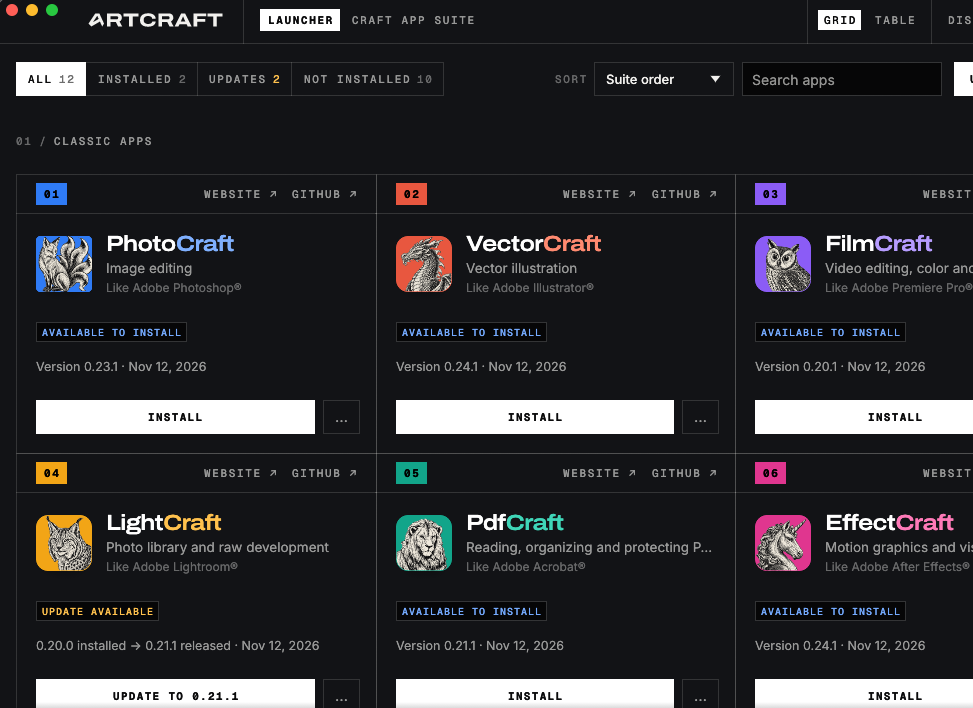
I also spent a few hours with DesignCraft which is their Adobe InDesign alternative and like we're still pretty far from that replacing InDesign as of right now. Great if you have some straight-forward needs for InDesign, but I think the Adobe moat is pretty strong there. InDesign people live or die by impossibly hard to detect errors.
All that said, I was surprised how close a lot of the features got. Especially considering this is an LLM written clean-room implementation. Now to be clear I'm not a lawyer and that explanation makes no sense to me. I don't know why a "clean-room rewrite by an LLM" would be better than you making a Lightroom knockoff by hand. Feels like the clean-room part is making this sound a lot more scientific than it is. But as I spent hours clicking around and trying things out, I started to get a pit in my stomach.
Moats
The best and worst thing about tech is that everything is constantly changing all the time. We've now gone from the moat being the price, distribution and shelf space to file formats, enterprise sales team to now the last remaining trickle of water being muscle memory and intellectual property. I was reading the interview in Ars with the folks behind this and the quote that popped out to me was "I one-shotted Photoshop. The whole thing". https://arstechnica.com/ai/2026/10/software-is-over-bold-ai-developer-takes-aim-at-adobe-with-open-source-clones/
That is a crazy sentence. If you aren't a developer, let me put it like this. Imagine if you read about the construction of Notre-Dame de Paris. Generations of workers, precise and hard to learn techniques, the whole thing. Some design elements we still don't fully understand today how they work. Then someone in Texas made a giant 3D printer that shot out a one to one copy in six months. Also there's a gift shop.
I increasingly think the way we think about moats and barriers in software was always wrong. I think the actual moat was the goodwill built up over decades, the trust that these were professional tools and the people behind them wanted the best for you. Plus the 15+ years of muscle memory and just comfort in this ecosystem. You can 3D print software but you cannot really clean-room generate trust.
But right now you don't need to, because every incumbent keeps giving their trust away, one dark pattern at a time.
So what does this mean for software, if Adobe and Microsoft cannot keep the moat going? What if CADCraft does get good enough to threaten AutoCAD, a product with muscle memory older than some nations? Are we ever going to sell desktop software again, or is the future just an endless series of clones, produced by LLMs, with what specific features you want?
I don't know. Meanwhile, the launcher has told me there's another update to the LLM Lightroom somehow. Right now the race feels weirdly inevitably, like watching a horse beat a car once and knowing in your heart that the car is gonna win in the end.